The GILD Standard
Our condition grading framework is designed to give collectors absolute clarity on what they are acquiring.
Every item listed on GILD Archive is evaluated and graded using a consistent, detail-driven process—so condition is never implied, assumed, or overstated.
Each piece is assessed individually, with attention to materials, construction, finish, functionality, and overall preservation.
The result is a clear, reliable condition grade that reflects the item as it exists today.
Our Grading Process
Every item consigned to GILD Archive undergoes a structured evaluation before being offered for sale.
Assessment includes:
Structural integrity and material condition
Surface wear, patina, and finish
Functional components (where applicable)
Completeness, accessories, and presentation
Grading is performed manually and documented with supporting photography to ensure transparency and consistency.
HOW DOES GRADING WORK?
Material & Surface Condition
We evaluate the visible and tactile condition of each item, focusing on materials, finish, structure, and overall preservation.
This includes assessment of surface wear, patina, edges, hardware, and craftsmanship details—documented exactly as observed, without enhancement or omission.
Structural & Functional Integrity
Where applicable, we assess functionality and structural soundness as part of the grading process.
This may include closures, hinges, fasteners, moving components, or mechanical function—ensuring the item performs as intended relative to its age and category.
Functional evaluation supports grading, but does not replace cosmetic documentation.
Documented Condition Report
Each item’s final condition designation is informed by the combined observations above and recorded in a clear, item-specific condition report.
Notes reflect all relevant details identified during evaluation, including prior restoration, refinishing, or alterations when present—so buyers understand not just the grade, but the reasoning behind it.
Setting the Gild Standard
Just as mileage offers insight into a car’s history, understanding an item’s condition is essential to informed collecting.
At GILD Archive, every piece is evaluated through a disciplined, category-appropriate process—examining materials, structure, finish, and overall preservation to determine its condition with clarity and consistency.
Our approach is not about embellishment or optimization. It is about documenting what exists, applying a standard evenly, and representing each item exactly as it stands.
We are committed to precision, restraint, and accountability—so buyers know the standard behind every listing.
Condition Grading at GILD Archive
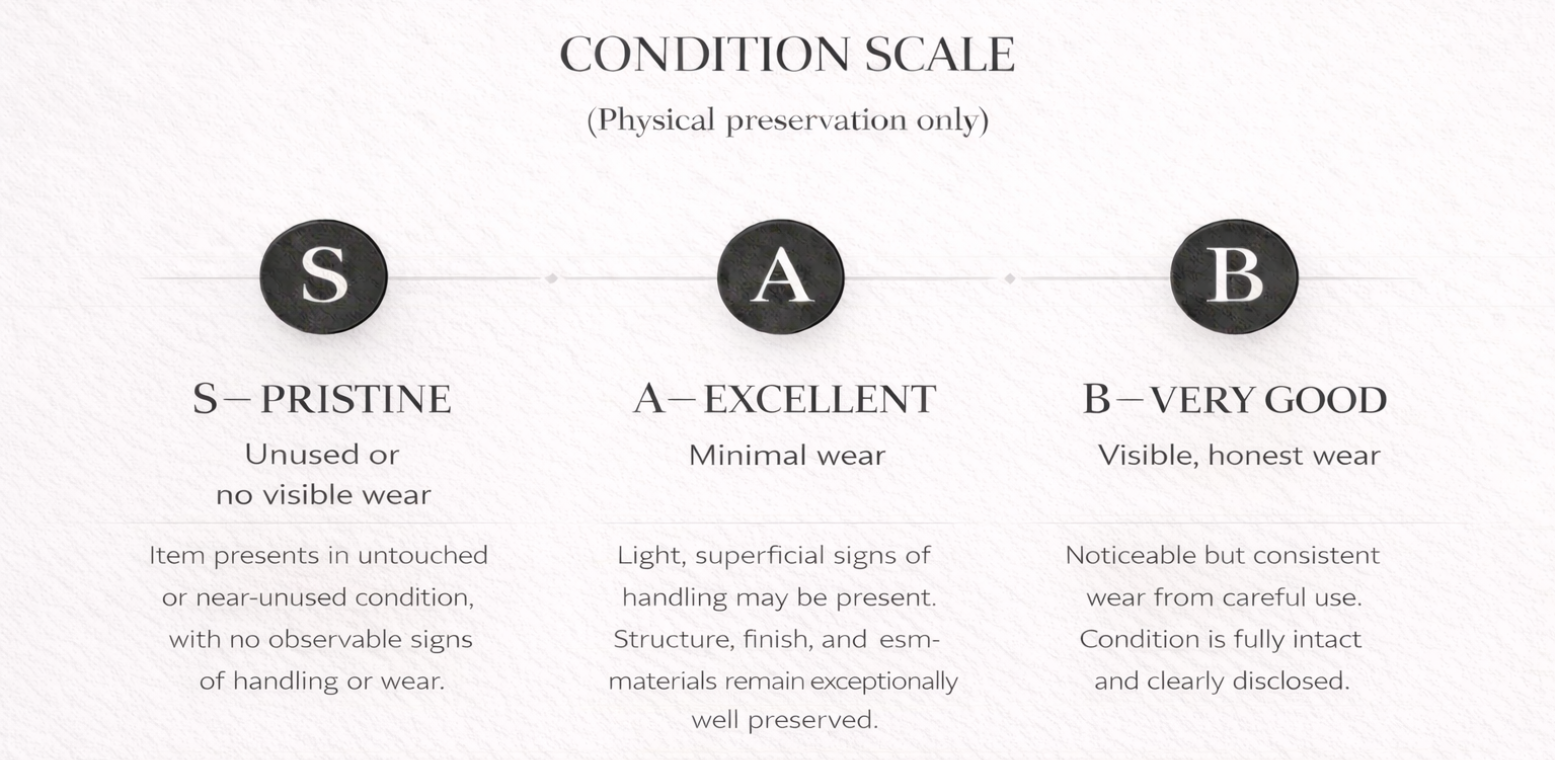
Every item listed on GILD Archive is evaluated using a consistent, letter-based grading system designed to reflect physical condition only.
Grades are applied conservatively and paired with clear descriptive language to ensure buyers understand exactly what they are acquiring—without exaggeration or ambiguity.
Frequently Asked Questions
Still have questions?
If you need additional clarification, our team is happy to help.
-
Grading at GILD Archive is performed using a consistent internal standard designed to reflect how serious collectors evaluate condition in practice.
Each item is assessed individually, documented carefully, and represented conservatively. We do not inflate grades to drive sales, nor do we generalize condition across categories. If an item cannot be evaluated with confidence, it is not listed.
-
The GILD Standard is our internal framework for evaluating and representing condition.
It considers material integrity, surface wear, structural soundness, functionality (where applicable), and overall preservation relative to age and use. This framework is applied consistently across all items in the archive.
-
Condition grades on GILD Archive are intended to provide clarity—not persuasion.
Grades summarize the overall state of an item, while accompanying photography and written descriptions provide the necessary context. Buyers are encouraged to review all listing details to fully understand condition.
-
Each item undergoes a hands-on evaluation prior to listing.
This includes close visual inspection, handling, and documentation of materials, construction, finish, and any notable characteristics. Functional components are assessed where relevant. All findings inform the final condition designation.
-
No.
Items must meet our documentation and representation standards to be listed. Pieces that cannot be accurately assessed, clearly documented, or responsibly represented are declined—even if rare or desirable.
-
Authenticity verification is conducted separately from condition grading.
Only items verified as authentic are eligible for listing. Condition grades reflect preservation and wear—not authenticity.
-
Internal condition reports are used to inform grading and verification, but they are not distributed to buyers.
Instead, buyers are provided with clear condition grades, detailed descriptions, and high-resolution images of the exact item offered.
-
GILD Archive does not offer repair or refurbishment services.
Items are listed in their current condition, with any prior restoration or refinishing disclosed when known.
-
Yes.
The same principles—accuracy, restraint, and transparency—are applied across watches, leather goods, accessories, and collectibles, with category-specific considerations taken into account.